


While Minnesota is violence center in the USA....here in Alabama.....no tear gas, no citizens shot...no ICE assaults.....

no, I am NOT complaining, just happy for the peace at home.
While Minnesota is violence center in the USA....here in Alabama.....no tear gas, no citizens shot...no ICE assaults.....
no, I am NOT complaining, just happy for the peace at home.
The north Alabama counties in the winter storm watch are Lauderdale, Colbert, Franklin, Lawrence, Limestone, Madison, Morgan, Marshall, Jackson, DeKalb and Cullman.
The National Weather Service in Huntsville said “moderate to heavy accumulations of snow, sleet, or ice are expected Friday night through Saturday night. Snow and sleet accumulations of at least 2 to 3 inches. Ice accumulations above one quarter of an inch. Locally higher amounts possible.”

As 2026 begins, it FEELS as if longer period is gone.
Time is always changing...faster and slower depending on many factors.

From a NY Times story:

"Now, under new ownership, CBS is rapidly transforming itself into a Trump-friendly network."
The American president’s vow to get Greenland, the semiautonomous Danish territory, has thrown the tiny, pro-American Nordic nation into crisis.
(and why should they NOT be bewildered by tRump? The rest of the universe is!)
An unusual word used this week that seems perfect as a way to describing tRump:
MARTIN LUTHER KING, JR. BIRTHDAY - MONDAY, JANUARY 19
Martin Luther King Jr. Day each year falls on the third Monday in January, creating the first three-day weekend of 2026. The day honors the life of the slain civil rights leader and is the second federal holiday of the year.
Whether you plan to stay home or enjoy a weekend away, Americans need to know what is open and closed for the upcoming holiday weekend. Here's more on closures so you can plan ahead:

This year, the holiday is observed on Monday, Jan. 19.
All federal, state, and municipal offices will be closed in observance of the holiday on Jan. 19. Martin Luther King Jr. Day is one of 11 federal holidays, according to the U.S. Office of Personnel Management.
Most federal workers and private sector workers are entitled to paid holiday time off. Public schools are also closed on Martin Luther King Jr. Day, however there are some exceptions with private schools.

The New York Stock Exchange, Nasdaq and bond markets will all be closed on Jan. 19. Those markets are typically open Monday through Friday, aside from select holidays.
Banks generally close on the same days as the Federal Reserve, which follows the federal holiday schedule above in 2026. Online bank transactions also aren't typically processed on federal holidays.
However, ATMs are often available for those who need to deposit or withdraw money on federal holidays.

The United States Post Office is also closed on all federal holidays in 2026 and does not deliver regular mail on those days.
The Post Office does still deliver items sent through Priority Mail Express on federal holidays, however. And customers can still "order stamps, print shipping labels, order boxes and other mail supplies, and request package pickups" on USPS.com during federal holidays, according to AARP.
FedEx will operate on a modified schedule for Martin Luther King Jr. Day, according to its website.
No UPS pickup or delivery service is offered on Jan. 19. However, UPS Express Critical service will be available that day, according to its website.
Public libraries will be closed on Martin Luther King Jr. Day. The state Department of Motor Vehicles (DMV) branches across the Empire State are also closed for the federal holiday.
City of Montgomery sanitation schedule" Monday & Thursday routes worked Tuesday (1/20/2026) only.
Tuesday & Friday routes worked Wednesday (1/21/2026) only.
Curbside trash is not scheduled.

WWW.MONTGOMERYAL.GOV
As of October 17, 2025
2025 SANITATION HOLIDAY SCHEDULE
NEW YEAR'S DAY - WEDNESDAY, JANUARY 1 - WORKING
No scheduled route changes.
MARTIN LUTHER KING, JR. BIRTHDAY - MONDAY, JANUARY 20 - CLOSED
Monday & Thursday routes worked Tuesday & Thursday.
Tuesday & Friday routes worked Wednesday & Friday.
Curbside trash is not scheduled.
PRESIDENTS' DAY - MONDAY, FEBRUARY 17 - WORKING
No scheduled route changes.
CONFEDERATE MEMORIAL DAY - MONDAY, APRIL 28 - WORKING
No scheduled route changes.
MEMORIAL DAY- MONDAY, MAY 26 - CLOSED
Monday & Thursday routes worked Tuesday & Thursday.
Tuesday & Friday routes worked Wednesday & Friday.
Curbside trash is not scheduled.
JEFFERSON DAVIS' BIRTHDAY - MONDAY, JUNE 2 - WORKING
No scheduled route changes.
JUNETEENTH - THURSDAY, JUNE 19 - CLOSED
Monday & Thursday routes worked Monday & Wednesday.
Tuesday & Friday routes no change.
Curbside trash is not scheduled.
FOURTH OF JULY - FRIDAY, JULY 4 - CLOSED
Monday & Thursday routes worked Monday (3/30/2025) only.
Tuesday & Friday routes worked Tuesday (4/1/2025) only.
Curbside trash is not scheduled.
LABOR DAY - MONDAY, SEPTEMBER 1 - CLOSED
Monday & Thursday routes worked Tuesday & Thursday.
Tuesday & Friday routes worked Wednesday & Friday.
Curbside trash is not scheduled.
COLUMBUS DAY - MONDAY, OCTOBER 13 - WORKING
No scheduled route changes.
VETERANS' DAY - TUESDAY, NOVEMBER 11 - WORKING
No scheduled route changes.
THANKSGIVING DAY - THURSDAY, NOVEMBER 27 AND FRIDAY, NOVEMBER 28 -
CLOSED
Monday & Thursday routes worked Monday (11/24/2025) only.
Tuesday & Friday routes worked Tuesday (11/25/2025) only.
Curbside trash is not scheduled.
CHRISTMAS DAY - THURSDAY, DECEMBER 25 AND DECEMBER 26 - CLOSED
Monday & Thursday routes worked Monday (12/22/2025) only.
Tuesday & Friday routes worked Tuesday (12/23/2025) only.
Curbside trash is not scheduled.

The American president’s vow to get Greenland, the semiautonomous Danish territory, has thrown the tiny, pro-American Nordic nation into crisis."
If it truly is a "Pro American" nation, how can there be a crisis?
HERE is the story.

The President's Media Hack to the CBS crew:
“He said, ‘Make sure you guys don’t cut the tape, make sure the interview is out in full,” Ms. Leavitt said in an even tone, according to a recording of the exchange obtained by The New York Times.
“Yeah, we’re doing it, yeah,” Mr. Dokoupil responded.
Ms. Leavitt replied: “He said, ‘If it’s not out in full, we’ll sue your ass off.’”
And Dokoupil agreed????????????????????????????????
Source: Here.
“If you look at some of the images out of Minneapolis last night. Look at this vehicle, look at what it says: It says ‘F ICE.’ You have these individuals who are putting their middle finger -- proudly so -- at the camera,” Leavitt said.
“People don’t do this without encouragement from people in power who make it feel like it’s O.K.,” the press secretary continued.
And let's not forget this:

A beating victim is a Beating victim is a beating victim.
Apparently not in Alabama.
From an ALCOM story:
"Senate Bill 20 would expand the list of protected professions to include “current or former” public officials, meaning an attack against them could trigger felony charges.
The legislation is also expected to add traveling health care workers, pharmacists, and social workers.
Professions already designated as a specialty class under Alabama law include police officers, firefighters, corrections officers, emergency medical service personnel, utility workers, teachers, and postal workers. Assaults against those workers while they are working in their jobs carry enhanced penalties.
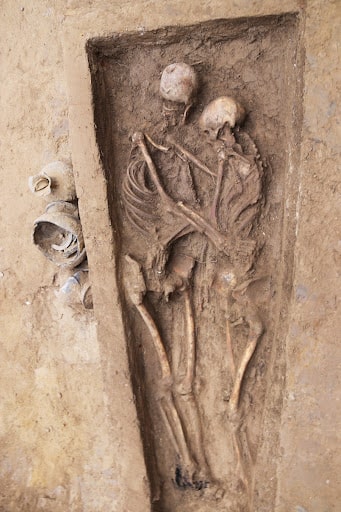
Archaeologists recently published a study of the tomb of cuddling lovers, dating to the Northern Wei Dynasty (386-534), more than 1,600 years ago, according to Jilin University.
In 2020, the tomb was initially unearthed in Datong City, Shanxi Province, north China. The couple was buried in the same grave in a single casket. The man had his arms around his lover’s waist, while the female had her head on his shoulder and was cuddled against his chest. A silver ring was also discovered on her left hand’s ring finger, according to the researcher.
Further skeletal examination indicated that the male tomb owner’s right arm had an unhealed infected fracture, whereas the female’s bones looked to be healthy. This finding suggests that the two may have killed themselves.

(Source: HERE)
From a NY Times story:
Mr. Trump’s comments were a blunt distillation of his administration’s racial politics, which rest on the belief that white people have become the real victims of discrimination in America. During his campaign for president, Mr. Trump harnessed a political backlash to the Black Lives Matter and other protests, saying there was “a definite anti-white feeling in this country,” and he joined his base in denouncing what he deemed to be “woke” policies.

 |
Full Story HERE.
.JPG)
The building was cooled by sliding huge blocks of ice into the basement and blowing air across the ice pile.


Patrick Lawler told year six pupils Rosa Parks ‘did not really exist’
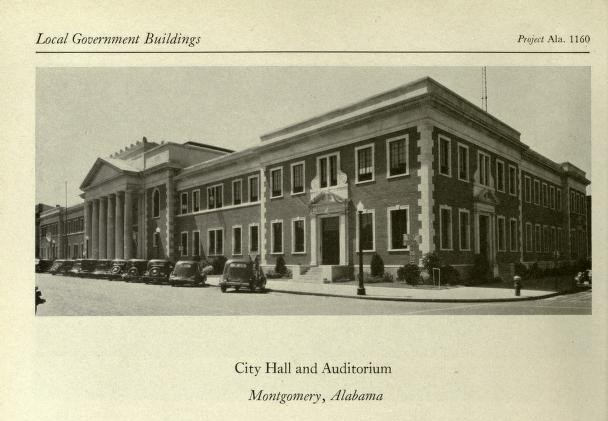
In a survey of federal projects constructed with PWA funding in 1939:
“The population of Montgomery, the capital city of Alabama, was
66,079 in 1930. Its city hall was destroyed by fire in 1932 and shortly
thereafter a grant from the P.W.A. made possible the construction of a
new building, which was placed on a site adjoining the State capitol. (Correction---it does NOT adjoin the state Capitol, and is in fact seven blocks away from it.)
It is two stories in height and accommodates the water department, police department, tax collector, health department, engineering department, and the mayor and his staff. In addition, it provides an auditorium with a seating capacity of 2,300, a stage, and miscellaneous offices.
The exterior walls are red brick trimmed with stone, and the building is fireproof throughout and air-conditioned. It is E-shaped in plan with over-all dimensions of 131 by 311 feet. It was completed at a construction cost of $623,815 and a project cost of $687,493.”

"The Atlanta Journal-Constitution will print its final edition TODAY, closing a 157-year chapter even as the newsroom doubles down on a digital future.
But inside and around the venerable institution, another story is unfolding: a chorus of veterans who built the paper — on copy desks and carrier routes, in pressrooms, bureaus and features sections — pausing to say goodbye to the thud on the lawn, the rumble of the presses, the ink that smudged fingers and white linen blouses."


"A teacher who told year six children that Rosa Parks "did not exist" and that Martin Luther King was guilty of plagiarism has been banned.
Patrick Lawler, 62, was found to have brought the teaching profession into disrepute after making a series of offensive comments.
Witnesses explained to the panel how he had told year six pupils in a transition day lesson that Martin Luther King was a “fraud and had embezzled lots of money”, and that Rosa Parks “did not really exist”.
The matter came to light when a parent complained about the lesson, which was meant to be on medieval history."
SOURCE: HERE.